
How a Salesforce Consulting Firm in Austin, Texas, Is Powering Manufacturing Growth in 2026
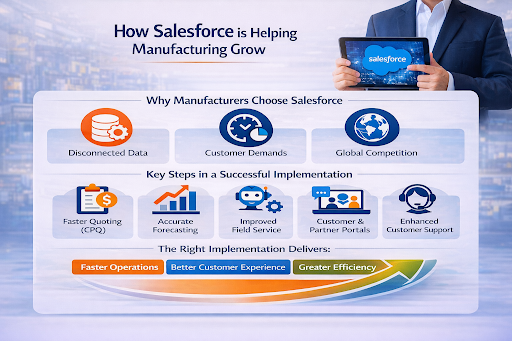
Austin's manufacturing sector is undergoing a significant shift — and it's happening on the ground, not just in boardrooms. Data that once lived in isolated systems is finally connecting across departments. Manual processes that consumed hours of a team's week are being replaced by automated workflows that simply run. Orders move through the pipeline with full visibility. Customers need to surface issues early, before they become costly problems.
Salesforce is at the center of this change. But the platform's real potential only emerges when it's configured around how a business actually operates—its sales rhythms, its production constraints, and its customer relationships. That's where local expertise matters. A consulting partner who understands the Austin market, its industries, and its pace of business doesn't just implement a system. They shape it into something that fits.
The difference between a Salesforce deployment that transforms operations and one that collects dust in six months almost always comes down to the partner behind it.
Why Austin Manufacturers Are Prioritizing Salesforce in 2026
Austin's manufacturing sector runs deep — aerospace components, medical devices, semiconductors, and advanced electronics all have a strong foothold here. These are industries where B2B sales cycles are long, procurement decisions are layered, and the pressure to digitize operations from end to end is no longer a future priority — it's today's reality. A few specific forces are pushing Salesforce to the top of the technology agenda right now:
- The supply chain chaos of the post-pandemic years made one thing painfully clear: most manufacturers were sitting on fragmented, siloed data. Sales had no visibility into live inventory. Operations found out about order changes too late. Finance was routinely working from numbers that were already outdated.
- The B2B buyer has fundamentally changed. Industrial procurement teams now arrive at the table expecting the same experience they get on Amazon — instant order visibility, self-service account access, and communication that feels timely and relevant, not generic.
- The competitive pressure is real and it's coming from multiple directions. Manufacturing hubs like Pune, India are digitizing fast. Staying operationally inefficient in sales and customer management is not a neutral choice anymore — it's a slow concession of market share.
- Salesforce itself has made a meaningful move toward the sector. The 2025–2026 Manufacturing Cloud updates — particularly around ERP connectivity and AI-powered demand forecasting — have closed gaps that previously made the platform a harder sell for industrial companies.
What a Salesforce Consulting Engagement Actually Delivers for Manufacturers
What a Salesforce Consulting Engagement Actually Delivers for Manufacturers
Most manufacturers walk into their first Salesforce conversation expecting a CRM pitch. What they get — from a consulting partner worth their time — is something far more grounded: a real conversation about where their operations are breaking down and what it would actually take to fix it.
A full manufacturing implementation typically covers:
Business Process Discovery
No workflow gets built until your consultants have spent serious time with your people. That means sitting with sales reps who've been working around broken processes for years, production managers juggling three systems that don't talk to each other, and service leads manually chasing order updates. The goal is to map how information actually moves through your business — not how it's supposed to on paper. This is where template-driven implementations fall apart. Manufacturing operations carry too much operational nuance for a one-size-fits-all setup to hold.
Salesforce Manufacturing Cloud Configuration
Manufacturing Cloud brings something that generic CRM deployments simply can't: a direct line between your sales commitments and your production reality. Account-Based Forecasting, Run Rate Agreements, and the Sales Agreement modules are built specifically to close the gap between what sales is promising and what the floor can actually deliver. When it's configured properly, your sales leadership and plant managers stop arguing over whose numbers are right — because they're finally looking at the same data.
ERP and Legacy System Integration
Of everything a Salesforce implementation service can deliver for a manufacturer, ERP integration tends to move the needle fastest. The moment Salesforce and your ERP are sharing live data, the daily friction your teams have quietly accepted for years starts to disappear. Sales reps stop making delivery promises they can't keep. Customer service stops putting callers on hold to dig through a separate system. Finance stops waiting on end-of-week reports to understand where revenue actually stands.
AI and Agentforce Deployment
Salesforce Agentforce is worth understanding clearly — because the hype around it often oversimplifies what it is. It's not a chatbot layer. It's an autonomous AI agent framework that sits inside your Salesforce environment and handles complex, multi-step workflows on its own: processing order change requests, escalating supply alerts to the right people, generating quotes for standard configurations, keeping tabs on contract compliance without anyone babysitting it. What makes this work in practice — not just in a demo — is the governance structure built around it. Any credible AI and machine learning solutions partner will tell you that deploying Agentforce without data governance and monitoring infrastructure isn't a shortcut; it's a liability.
Customer and Partner Portals (Experience Cloud)
There's a version of customer experience that manufacturers have been slow to adopt — one their buyers have quietly started expecting. Experience Cloud makes it possible to give customers a branded self-service portal where they can track their own orders, raise service requests, and pull documentation without picking up the phone. For businesses running distributor or dealer networks, the partner portal side of Experience Cloud is equally valuable: deal registration, shared pipeline visibility, collaborative lead management. The teams that have rolled this out consistently report fewer inbound support calls and noticeably better satisfaction scores — not because the product changed, but because the experience around it finally caught up.
Where Salesforce Delivers the Highest ROI in Manufacturing
Not every Salesforce module delivers equal impact across every industry — but in manufacturing, four use cases have proven themselves repeatedly. These are the areas where Austin-area companies see results quickly, and where the business case becomes impossible to argue with.
- CPQ Automation (Configure, Price, Quote): Quoting errors are one of the quietest margin killers in manufacturing sales. Salesforce CPQ addresses this directly — it enforces pricing rules, manages discount approval workflows, and validates product configuration logic before a quote ever reaches a customer. The result is a turnaround that shrinks from days to hours, with far fewer costly corrections after the fact. A number of manufacturers have found that CPQ alone generates enough efficiency gains to justify the broader Salesforce investment.
- Unified Sales and Operations Forecasting: The tension between what sales commits to and what operations can realistically fulfil is a familiar pain point in manufacturing. Manufacturing Cloud's Sales Agreements module — when connected to live ERP data — gives both teams visibility into the same numbers at the same time. It does not eliminate every disagreement, but it removes the information gap that causes most of them.
- Field Service Optimization: For manufacturers with equipment running at customer sites, service responsiveness is a direct reflection of brand reliability. Salesforce Field Service brings structure to scheduling, routes technicians more efficiently, and gives customers real-time visibility into when help is arriving. When IoT data is layered in, the system can detect early warning signals and trigger a service case before the customer even notices a problem — shifting the model from reactive to genuinely predictive — something VirtueByte's manufacturing case study demonstrates in practice
- After-Sales Service and Warranty Management: Once a product ships, the service relationship begins — and Service Cloud ensures that relationship is managed with full context. Every customer interaction, every unit shipped, every open case sits in one place. Warranty claim processing that previously stretched across weeks gets compressed to days, and the service team is no longer piecing together history from disconnected systems.
What Separates Great Implementations from Average Ones
Choosing the wrong consulting partner doesn't just slow you down — it can turn a six-figure Salesforce investment into a system your team quietly stops using. The difference between an implementation that drives growth and one that collects dust almost always comes down to how the partner works, not just what they know. Across successful manufacturing deployments, four qualities show up every time:
- Process-first thinking: The consultants who deliver the best outcomes spend more time questioning your current workflows than they do configuring the platform. They will push back, ask uncomfortable questions, and sometimes tell you that a process needs to change before Salesforce touches it. That friction is exactly what you're paying for. Technology amplifies whatever process it sits on — build on a broken one, and you've just made the problem faster.
- Manufacturing domain depth: There's a meaningful gap between a consultant who has read the Manufacturing Cloud documentation and one who has sat across the table from a procurement director trying to reconcile run-rate contracts, dealer management structures, and a bill of materials that's changed three times this quarter. Knowing the platform is necessary but not sufficient. The nuance of industrial sales cycles, distributor relationships, and production-linked pricing is what separates a genuinely tailored solution from one that looks right on paper and frustrates users in practice.
- Real change management and training: Software doesn't fail — adoption does. The strongest implementations treat user adoption as a hard project deliverable, not a footnote in the closing phase. That means role-specific training built around how your team actually works, not generic walkthroughs. It means documentation that a new hire can pick up six months after go-live and actually use. It means someone on the consulting team is accountable for whether people are using the system, not just whether the system is live.
- Ongoing managed services: A go-live date is not a finish line — it's closer to a starting gun. Salesforce releases three major platform updates every year, and your business processes won't stay static either. The implementations that continue delivering value are the ones supported by a dedicated managed services partner who monitors performance, handles release cycles proactively, and pushes enhancements as your needs evolve. A one-time deployer hands you the keys and moves on. A long-term partner stays invested in your outcomes.
The Right Partner Makes All the Difference
Most manufacturers don't fail at Salesforce because the platform is wrong for them. They fail because the implementation wasn't built around how their business actually works. The ones getting it right — shorter sales cycles, cleaner operations, stronger customer retention, and real after-sales revenue — made one decision differently. They chose a partner who understood manufacturing before they understood CRM.
A credible Salesforce consulting firm in Austin, Texas doesn't just show up with certifications and a project plan. They've seen your problems before. They know where the ERP integration breaks down at 3 AM, why the sales team stops logging activity after week four, and what a run-rate agreement actually looks like in practice — not just in a demo. That kind of knowledge doesn't come from a course. It comes from doing it, repeatedly, across manufacturers who were just as skeptical as you probably are right now.
Austin's manufacturing sector is heading into a significant stretch of growth. The companies that will lead it aren't necessarily the biggest — they're the ones who built the right operational foundation while others were still debating whether to invest.
Related Blog Posts

Driving Manufacturing Growth with Salesforce
Salesforce simplifies the entire sales cycle — from capturing leads to closing deals. With 360° customer views, real-time dashboards, and accurate revenue forecasting, sales teams work smarter and faster.
Learn More
BI for Manufacturing Industry
The project involves building a data warehouse with facts and dimensions for the manufacturing industry, using SQL scripts to populate the database structure.
Learn More
ML for Test Case Generation and Classification
This project focuses on using Machine Learning to automate test case generation from user stories. It involves pre-processing user stories with NLP to extract actions and expectations.
Learn More