
Modern IT Consulting Services : Aligning Technology with Business Strategy in 2026
What IT Consulting Actually Means in 2026
The definition of IT consulting has shifted significantly. A decade ago, it mostly meant help desk support, hardware setup, and network troubleshooting. Those needs still exist — but they represent the floor, not the ceiling.
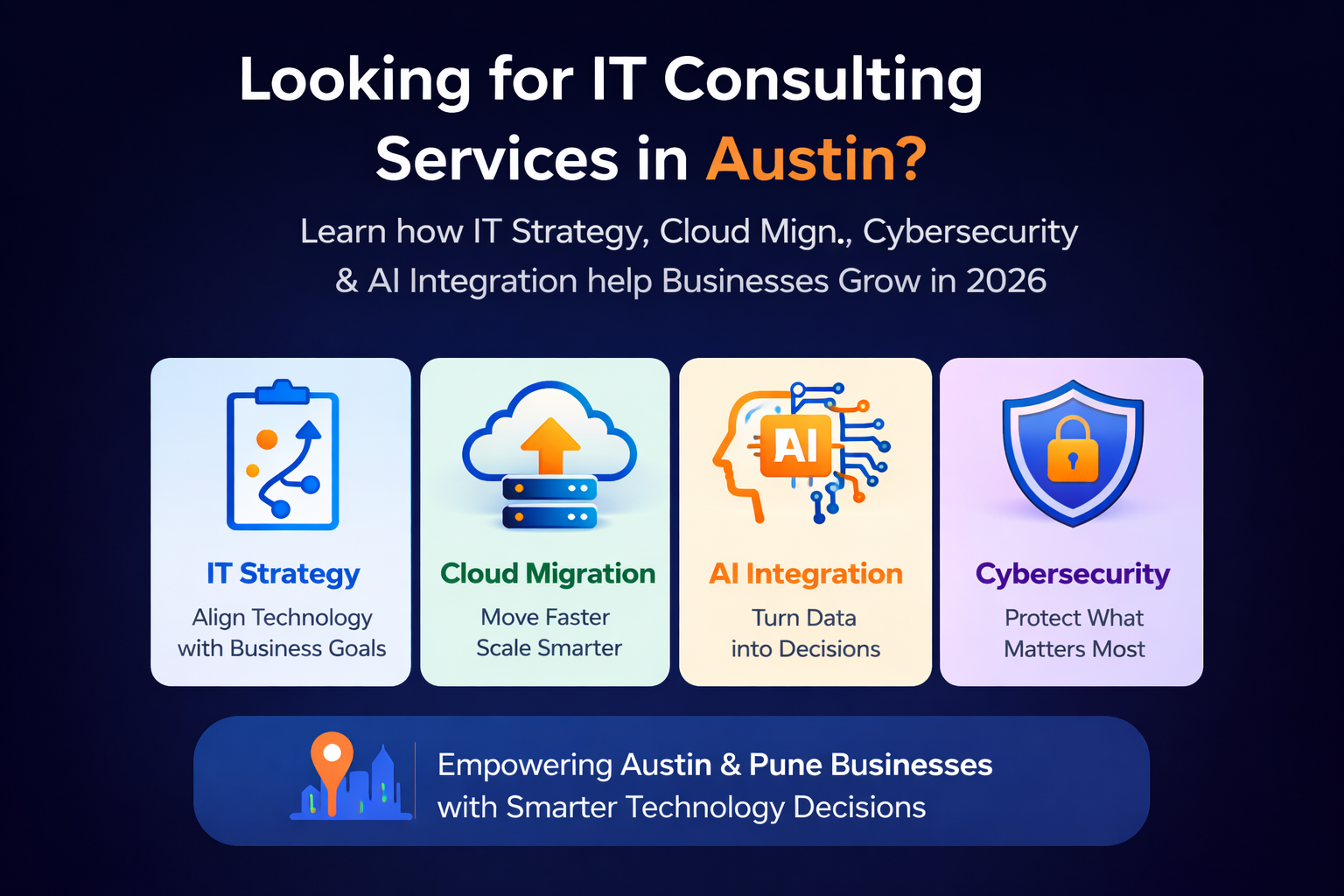
Today, IT consulting services cover the full spectrum of business technology strategy: cloud setups, cyber security, software linking, AI preparedness, legal compliance, digital shift plans. Good consultants don't just patch systems — they connect tech to real business goals. Every investment must either fix a daily problem or create a new way to grow. In Austin's crowded tech scene, this difference hits harder than anywhere else. The city draws sharp buyers who've seen generic IT advice fall apart. And they want something grounded in business needs — not just a push for a product.
Why Austin Businesses Are Rethinking Their IT Strategy Right Now
Austin's business environment in 2026 is defined by three pressures that make strategic IT guidance more urgent than it's ever been:
- The AI Integration Pressure
Every department is feeling it — sales wants smarter lead scoring, operations wants to cut manual approvals, finance wants better forecasting, customer service wants faster resolution. The pressure to extract more output from the same team is real, and right now, the answer everyone reaches for is AI.
The problem is that AI tools only perform as well as the data feeding them. Walk into most mid-sized businesses and what you'll find is a data environment that was never designed to be clean, connected, or consistent — it just grew that way. An experienced IT strategy consultant gets into that environment before the AI initiative does. They find the gaps, the duplicate records, the disconnected systems. That work isn't glamorous, but skipping it is how AI projects burn through budget without producing anything useful.
- The Cybersecurity Reality
It used to be that cyberattacks were primarily an enterprise problem. That's no longer true. Austin's mid-market and SMB sectors are squarely in the crosshairs now — ransomware operators, phishing campaigns, and credential-theft attacks have moved down-market because smaller businesses are easier targets and still hold valuable data.
Businesses without a documented cybersecurity consulting and risk management strategy are increasingly finding that cyber liability coverage is either unavailable to them or priced out of reach. IT consulting services that include a proper security assessment and remediation roadmap have gone from a nice-to-have to a baseline operating requirement — not because of best-practice guidelines, but because the business cost of going without one is now quantifiable and high.
- The Cloud Complexity Curve
Ask most Austin businesses whether they're "in the cloud" and the honest answer is: sort of. What they actually have is a mix — some SaaS tools adopted department by department, a legacy system or two that IT has quietly kept on-premise because migration felt risky, and a handful of integrations that work most of the time. Each decision made sense when it was made. Together, they create a technology environment that's harder to manage, harder to secure, and harder to scale than it should be.
Cloud migration consulting and ongoing IT infrastructure management look at that whole picture honestly and help businesses figure out what to consolidate, what to retire, and what to actually modernize.
- Core Services That Drive Real Business Outcomes
The IT consulting engagements that actually move the needle begin with the business, not the technology. Before any recommendation is made, the consultant needs to understand how the company makes money, where the friction is, and what's being asked of the team that the current systems can't support. For businesses in Austin and Pune, here's where that kind of engagement tends to generate the most measurable impact:
- IT Strategy and Technology Roadmapping
Most technology purchases are reactive — a system breaks, a competitor launches a new capability, someone in leadership reads about a platform and asks why we aren't using it. Reactive buying is expensive and creates a patchwork that becomes progressively harder to manage.
A technology roadmap sequences IT investments around business milestones — hiring phases, market expansion, product launches — so that the infrastructure is ready when it's needed, not purchased in a scramble after the need appears. For a growing business, a well-maintained roadmap is one of the quieter but more valuable assets on the operations side.
- Cybersecurity Assessment and Risk Management
There's a meaningful gap between buying security tools and actually understanding what's vulnerable in your environment. Most businesses have more exposure than their tools acknowledge — it shows up in overprivileged user accounts, third-party integrations with broad data access, and endpoint devices that haven't been patched in months.
A proper assessment starts by mapping the attack surface specific to that business and ranks remediation priorities by actual risk exposure, not by what a vendor's marketing material emphasizes.
- AI Readiness and Data Integration
The fastest way to get a disappointing return from an AI investment is to deploy it on top of data that wasn't built to support it. Disconnected systems, inconsistent data formats, and absent governance structures don't disappear when you add an AI layer — they show up as unpredictable outputs and tools that staff stop trusting within weeks of launch.
IT consultants who specialize in AI & machine learning solutions treat data architecture as the prerequisite, not the afterthought. The AI initiative gets built on something solid — and the results reflect it.
What Separates a Strategic IT Partner from a Vendor
Most businesses that are quietly frustrated with their IT situation aren't dealing with a bad vendor. They're dealing with the wrong kind of relationship entirely.
A vendor reacts to tickets. A strategic partner is already working on the problem before it becomes one. A vendor recommends what they sell. A strategic partner tells you what the business actually needs — even when that answer is simpler, cheaper, or comes from somewhere else entirely. A vendor delivers a project, marks it complete, and moves on. A strategic partner stays in the room through adoption, through the friction that follows go-live, and into whatever comes next.
When evaluating IT consulting services in Austin, a few questions make it obvious quickly: Does your consultant actually understand how your business makes money? Are they bringing issues to your attention, or are you always the one who notices something is wrong first?
If those answers feel uncertain, that's not a technology problem. It's a partnership problem, and it's fixable.
Building Technology That Works for the Business, Not Around It
The companies getting IT right in 2026 — in Austin, in Pune, and everywhere in between — share one trait: they stopped treating technology as a cost centre and started treating it as infrastructure for growth. That shift doesn't happen on its own. It requires a consulting partner who can hold both the technical and the business view simultaneously.
If your current IT setup feels more like a constraint than an enabler, the answer isn't necessarily new tools. It's a clearer strategy for using the ones you have — and a partner who helps you see the difference.
Related Blog Posts
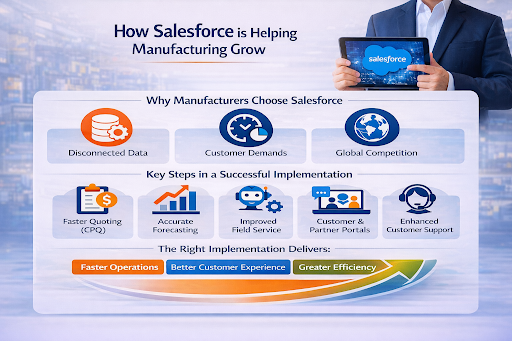
How a Salesforce Consulting Firm in Austin, Texas, Is Powering Manufacturing Growth in 2026
Discover how a Salesforce consulting firm in Austin, Texas is transforming manufacturing in 2026 - AI automation, ERP integration, CPQ, and real ROI. Learn what great implementations actually look like.
Learn More
Driving Manufacturing Growth with Salesforce
Salesforce simplifies the entire sales cycle — from capturing leads to closing deals. With 360° customer views, real-time dashboards, and accurate revenue forecasting, sales teams work smarter and faster.
Learn More
BI for Manufacturing Industry
The project involves building a data warehouse with facts and dimensions for the manufacturing industry, using SQL scripts to populate the database structure.
Learn More