
When Business Growth Outpaces Technology: The Hidden Operational Challenges Organizations Face
Introduction
Growth is exciting for any business.
More customers, more projects, more transactions, and more opportunities are usually signs that the business is moving in the right direction.
However, growth often brings a challenge that many organizations do not anticipate.
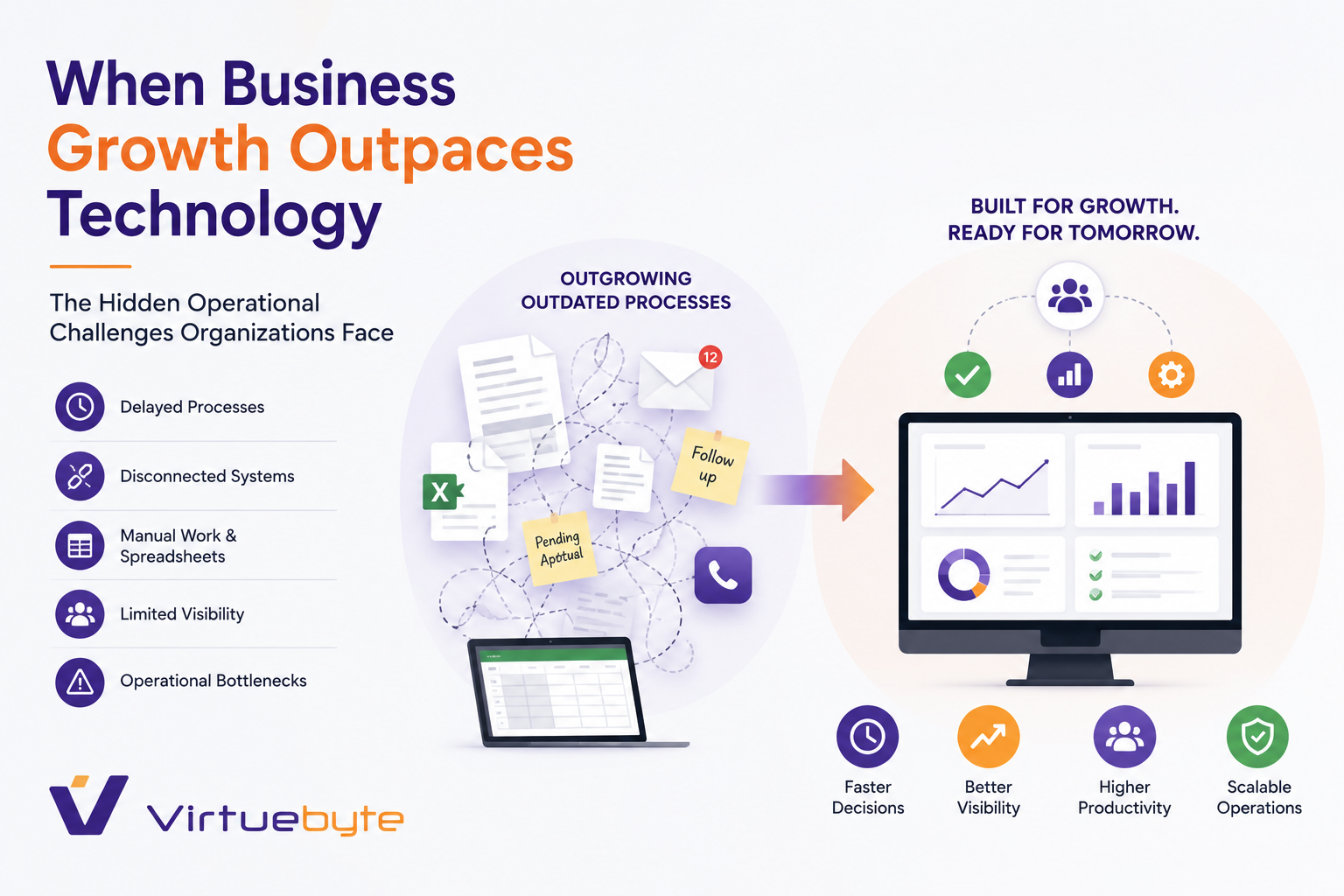
The processes and systems that worked perfectly when the business was smaller may no longer support the demands of a growing organization.
Many businesses invest in new technologies, hire more people, and expand operations. Yet they continue to experience delays, inefficiencies, and operational bottlenecks.
The problem is not always a lack of technology.
Often, the business has simply grown faster than its processes and systems.
This is when business growth begins to outpace technology.
The Early Days: When Simple Processes Work
Most businesses start with simple and manageable operations.
Teams communicate directly.
Approvals happen quickly.
Customer information is easy to track.
Reports can be created manually.
At this stage, spreadsheets, emails, and manual processes often work well enough.
With fewer employees and customers, coordination is relatively easy.
There is little pressure on systems because the volume of work remains manageable.
The challenge begins when the business starts growing.
What Changes as the Business Grows?
As organizations expand, operational complexity increases.
Businesses often experience:
- More customers to manage
- Larger sales pipelines
- More invoices and transactions
- Multiple departments working together
- Higher customer expectations
- More approvals and compliance requirements
While growth is positive, it also creates pressure on existing systems and processes.
Processes that once worked smoothly may suddenly become difficult to manage.
Common Signs That Growth Is Outpacing Technology
Many organizations do not realize there is a problem until operational challenges become visible.
Some common warning signs include:
Increasing Dependence on Spreadsheets
Different teams maintain their own spreadsheets to manage information.
As data grows, maintaining consistency becomes difficult.
Teams spend more time updating spreadsheets than making decisions.
Information Is Scattered Across Multiple Systems
Customer information may exist in one system.
Operational data may exist in another.
Financial information may be stored somewhere else.
As a result, employees spend valuable time searching for information instead of acting on it.
More Manual Follow-Ups
Employees regularly send emails, make calls, and follow up manually to move work forward.
Processes depend heavily on people remembering what needs to happen next.
This increases delays and creates operational risks.
Growing Operational Bottlenecks
As workloads increase, approvals, validations, and coordination activities begin creating delays.
The business starts spending more effort managing processes than serving customers.
Why Adding More People Is Not Always the Answer
When businesses face operational challenges, the first instinct is often to hire more people.
While additional resources may help temporarily, they do not always solve the underlying problem.
In fact, adding more people to inefficient processes can sometimes increase complexity.
More people often mean:
- More communication
- More handoffs
- More approvals
- More coordination
Without process improvements, inefficiencies continue to grow.
The focus should not only be on increasing resources.
The focus should be on improving how work flows through the organization.
Understanding the Real Problem
Many leaders assume they have a technology problem.
In reality, they often have a process alignment problem.
Technology may already exist.
The challenge is that:
- Systems are not connected
- Workflows are fragmented
- Data is not flowing efficiently
- Teams are operating independently
As a result, employees create manual workarounds to keep operations moving.
Over time, these workarounds become part of daily operations.
This creates hidden inefficiencies that slow down growth.
The Shift from Reactive Operations to Structured Operations
Growing organizations eventually reach a point where they need more than individual effort and manual coordination.
They need structured operations.
This involves:
Standardizing Processes
Clear and repeatable processes reduce confusion and improve consistency.
Teams understand responsibilities and expectations more clearly.
Improving Visibility
Business leaders need real-time visibility into operations.
When information is available at the right time, decisions become faster and more effective.
Reducing Manual Dependencies
Organizations should aim to reduce repetitive activities that consume valuable employee time.
This allows teams to focus on higher-value work.
Connecting Business Functions
Sales, operations, finance, and customer service should function as connected parts of the same business process.
When departments work together effectively, overall efficiency improves.
The Business Impact of Better Alignment
Organisations that successfully align technology with business operations often experience significant improvements.
Faster Decision-Making
Better visibility allows leaders to identify issues early and act quickly.
Improved Productivity
Employees spend less time searching for information and more time completing meaningful work.
Better Customer Experience
Faster processes and improved coordination lead to better customer service.
Reduced Operational Risk
Structured workflows reduce errors, missed approvals, and process inconsistencies.
Greater Scalability
The organisation becomes better prepared to handle future growth without significantly increasing operational complexity.
Looking Beyond Technology
Technology is important.
However, technology alone does not solve business challenges.
The real value comes when technology supports how the business operates every day.
Organisations that focus only on implementing systems often struggle to achieve expected results.
Organisations that align technology with people, processes, and operations create stronger foundations for growth.
Conclusion
Business growth is a positive sign, but growth also introduces new operational challenges.
Processes that worked well in the early stages of a business may not support larger teams, higher transaction volumes, and increasing customer expectations.
When growth begins to outpace technology, organizations often experience delays, inefficiencies, and operational bottlenecks.
The solution is not simply investing in more technology.
The solution is ensuring that systems, workflows, and business operations evolve together.
Because sustainable growth is not just about doing more work.
It is about building processes and operations that can scale with the business.
\
Related Blog Posts

When Business Growth Outgrows the Way Work Gets Done
Business growth does not only bring more customers, employees, and revenue. It also changes how work needs to move through the organization. Learn how growing businesses can recognize when existing processes are no longer supporting the way the business operates today—and how better processes and technology can help reduce unnecessary complexity.
Learn More
The Silent Costs Businesses Don't Measure: How Everyday Operational Inefficiencies Impact Growth
As a business grows, the challenges are not always about finding more customers or hiring more people. Sometimes, the bigger challenge is managing the work that already exists. Manual follow-ups, repeated data entry, delayed approvals, and disconnected systems can quietly consume time and slow growth. This article looks at these everyday operational costs and why businesses should pay attention to them before they become bigger problems.
Learn More
The Silent Costs Businesses Don't Measure: How Everyday Operational Inefficiencies Impact Growth
As a business grows, the challenges are not always about finding more customers or hiring more people. Sometimes, the bigger challenge is managing the work that already exists. Manual follow-ups, repeated data entry, delayed approvals, and disconnected systems can quietly consume time and slow growth. This article looks at these everyday operational costs and why businesses should pay attention to them before they become bigger problems.
Learn More