
Intelligent Invoice Reconciliation: How Automated PO and Invoice Matching Improves Financial Accuracy
Introduction
For many finance teams, invoice processing appears straightforward on the surface.
A vendor sends an invoice. The finance team verifies it against purchase records. The invoice is approved, processed, and payment is released.
However, as businesses grow and transaction volumes increase, this seemingly simple process becomes one of the most time-consuming and error-prone activities within finance operations.
Organizations often receive invoices from multiple vendors across different locations, departments, and projects. These invoices arrive in different formats, contain varying levels of detail, and must be validated against internal purchase records before payments can be processed.
In many cases, finance teams still rely on manual verification to compare invoices with purchase orders, release orders, contracts, or procurement records.
While this approach may work for smaller volumes, it quickly becomes inefficient as operations scale.
The challenge is no longer processing invoices.
The challenge is ensuring accuracy, consistency, and control while maintaining operational efficiency.
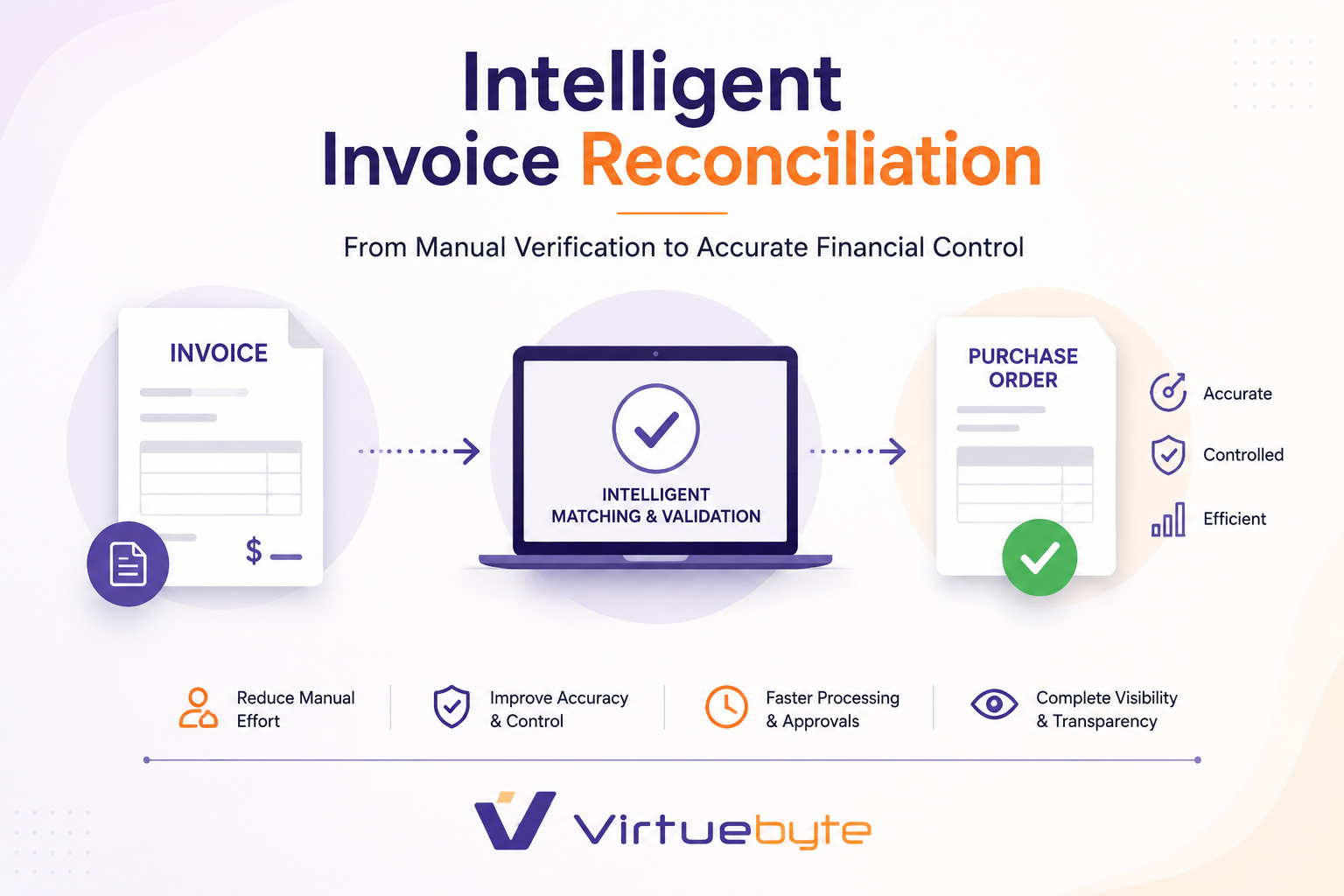
This is where intelligent invoice reconciliation and automated matching frameworks are creating measurable business value.
The Growing Challenge of Manual Invoice Reconciliation
Most organizations have established procurement and finance processes.
Purchase requests are raised, approvals are completed, orders are issued, goods or services are delivered, and invoices are submitted for payment.
The difficulty begins when finance teams must verify whether every invoice accurately matches the original purchase commitment.
This typically requires validation of:
- Vendor information
- Purchase order references
- Line-item details
- Product quantities
- Pricing information
- Tax calculations
- Payment terms
- Total invoice values
When this process is performed manually, finance teams spend considerable time reviewing documents line by line.
The larger the organization becomes, the more complex the challenge grows.
A company processing hundreds or thousands of invoices every month may require significant manual effort simply to validate information before payments can be approved.
As a result, finance professionals often spend more time validating data than performing higher-value financial analysis.
Common Problems Faced by Finance Teams
Manual invoice reconciliation introduces several operational risks.
Human Errors
Even experienced finance professionals can overlook discrepancies when reviewing large volumes of invoices.
Small errors in quantities, pricing, or tax calculations can lead to inaccurate payments and financial inconsistencies.
Duplicate Payments
Without automated verification, duplicate invoices may enter the payment process.
These duplicate payments create financial losses and require additional effort to identify and recover.
Delayed Approvals
When discrepancies are discovered, invoices often move through multiple rounds of communication between finance, procurement, operations, and vendors.
This significantly increases approval timelines.
Limited Visibility
Organizations frequently struggle to answer questions such as:
- Which invoices are pending validation?
- Which invoices contain exceptions?
- What is causing payment delays?
- Which vendors generate the highest number of discrepancies?
Without centralized visibility, decision-making becomes difficult.
Audit and Compliance Risks
Manual processes often create gaps in documentation and approval trails.
During audits, retrieving historical validation records can become a time-consuming exercise.
As regulatory requirements increase, organizations need stronger financial controls and traceability.
Why Traditional Automation Is Often Not Enough
Many organizations attempt to improve efficiency by digitizing invoice storage or implementing basic workflow approvals.
While these initiatives reduce paper-based processes, they do not fully address the reconciliation challenge.
The fundamental problem remains:
The system still depends on humans to compare invoice information against internal purchase records.
Finance teams continue to spend valuable time verifying:
- Does the invoice match the purchase order?
- Are quantities correct?
- Are pricing values accurate?
- Have taxes been calculated properly?
- Has this invoice already been processed?
True transformation requires moving beyond document storage toward intelligent data validation.
Our Approach
Rather than focusing only on invoice processing, the objective was to improve the overall financial validation workflow.
The approach focused on:
- Creating a more structured invoice management process
- Reducing dependency on manual verification
- Improving visibility across finance and procurement teams
- Introducing intelligent validation mechanisms
- Streamlining exception handling and approvals
- Building stronger operational controls
This allowed the organization to move from a reactive process to a more structured and scalable operating model.
Methodology Followed
The engagement was executed in four stages:
Understanding Existing Operations
The first step was understanding how invoices were received, validated, approved, and processed across teams.
This helped identify process bottlenecks, approval delays, and areas heavily dependent on manual effort.
Process Simplification
Existing workflows were reviewed and redesigned to eliminate unnecessary handoffs and repetitive validation activities.
The focus was on creating a smoother and more transparent operational flow.
Workflow Automation
Key validation and approval activities were aligned within a structured workflow to improve consistency and reduce manual intervention.
Visibility and Control
A centralized view of processing status, exceptions, and pending actions helped stakeholders gain better operational visibility.
The Business Impact of Intelligent Reconciliation
Organizations implementing intelligent invoice reconciliation often experience benefits beyond finance operations.
Improved Financial Accuracy
Automated validation reduces the risk of human errors and incorrect payments.
Faster Processing Cycles
Routine verification is completed automatically, reducing approval timelines.
Reduced Manual Workload
Finance teams spend less time validating invoices and more time focusing on strategic financial activities.
Better Operational Visibility
Real-time dashboards provide insights into:
- Pending invoices
- Exception cases
- Processing timelines
- Vendor performance
Stronger Compliance and Audit Readiness
Every validation step, approval action, and exception resolution is captured within the system.
This creates a clear audit trail and simplifies compliance requirements.
Lower Risk of Duplicate Payments
Automated duplicate detection protects organizations from unnecessary financial losses.
Looking Beyond Automation
The real value of intelligent invoice reconciliation is not simply processing invoices faster.
Its greatest benefit is creating confidence in financial operations.
When invoice data is automatically validated against purchase commitments, organizations gain:
- Greater financial control
- Better operational transparency
- Improved decision-making
- Stronger compliance
- More scalable finance processes
Instead of spending time searching for errors, finance teams can focus on improving business performance.
Conclusion
As organizations continue to scale, manual invoice reconciliation becomes increasingly difficult to manage.
The combination of growing transaction volumes, compliance requirements, and operational complexity creates a strong need for smarter financial processes.
Intelligent invoice reconciliation transforms invoice processing from a labor-intensive activity into a structured, automated, and highly controlled workflow.
By combining OCR, automated matching, business rule validation, and exception management, organizations can significantly improve financial accuracy while reducing manual effort.
The result is not simply faster invoice processing.
The result is a finance function that operates with greater accuracy, visibility, and confidence—enabling the business to grow without increasing operational complexity.
\
Related Blog Posts

When Business Growth Outgrows the Way Work Gets Done
Business growth does not only bring more customers, employees, and revenue. It also changes how work needs to move through the organization. Learn how growing businesses can recognize when existing processes are no longer supporting the way the business operates today—and how better processes and technology can help reduce unnecessary complexity.
Learn More
The Silent Costs Businesses Don't Measure: How Everyday Operational Inefficiencies Impact Growth
As a business grows, the challenges are not always about finding more customers or hiring more people. Sometimes, the bigger challenge is managing the work that already exists. Manual follow-ups, repeated data entry, delayed approvals, and disconnected systems can quietly consume time and slow growth. This article looks at these everyday operational costs and why businesses should pay attention to them before they become bigger problems.
Learn More
The Silent Costs Businesses Don't Measure: How Everyday Operational Inefficiencies Impact Growth
As a business grows, the challenges are not always about finding more customers or hiring more people. Sometimes, the bigger challenge is managing the work that already exists. Manual follow-ups, repeated data entry, delayed approvals, and disconnected systems can quietly consume time and slow growth. This article looks at these everyday operational costs and why businesses should pay attention to them before they become bigger problems.
Learn More