
When Salesforce Implementation Is Not Enough: Aligning Systems with Business Operations
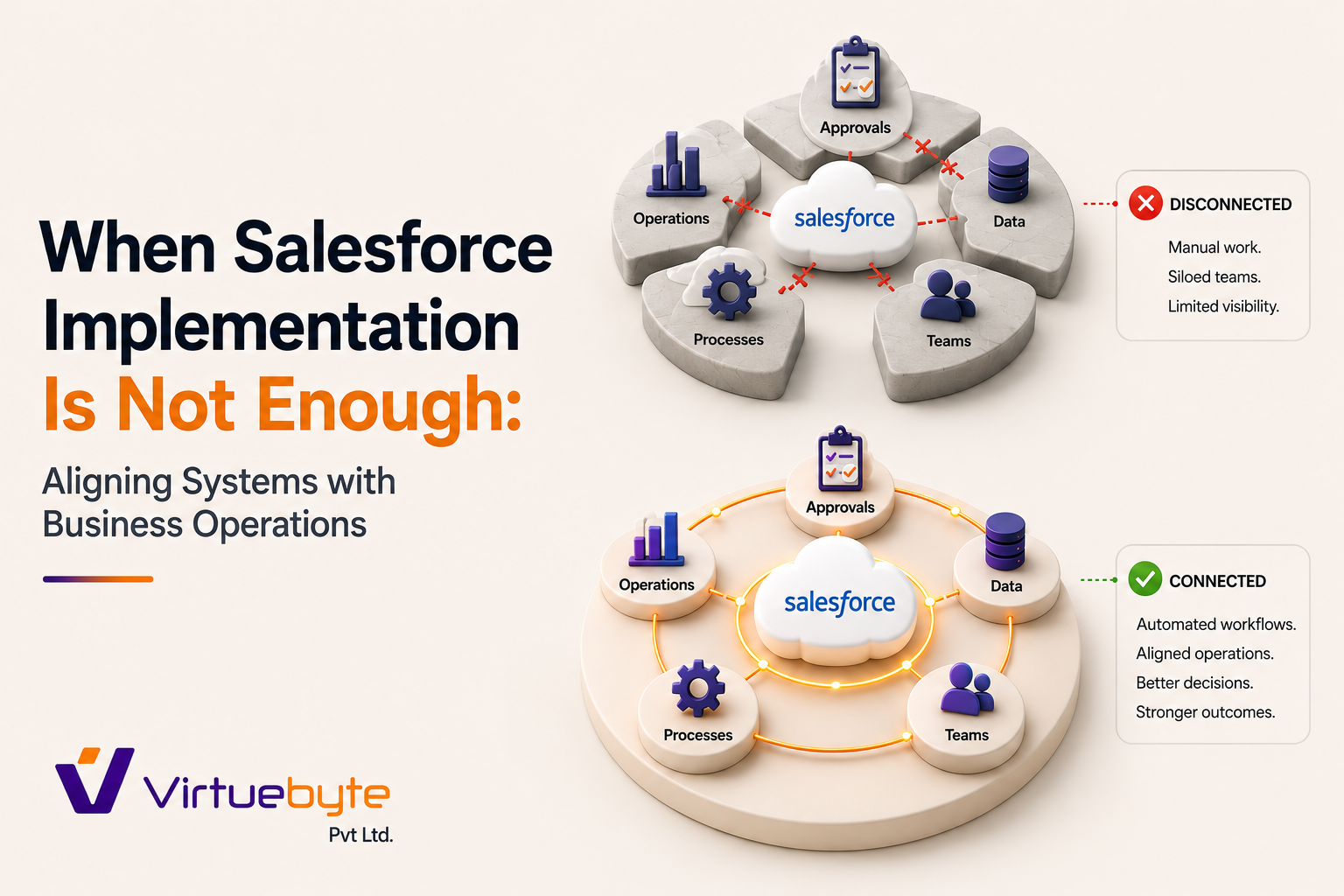
Many organizations already have platforms like Salesforce in place to manage sales, quotations, approvals, and customer workflows.
At a technical level, the system is active and being used across departments.
But over time, many businesses begin facing a different challenge.
The issue is no longer about implementing software.
The real challenge becomes aligning the system with actual day-to-day business operations.
In many cases:
- Teams still depend on manual coordination
- Approvals happen outside the system
- Operational data moves across emails and spreadsheets
- Different departments work in isolated process stages
- Visibility across operations becomes limited
As businesses grow, these disconnected workflows create delays, dependency on individuals, and operational inefficiencies.
Understanding the Operational Gap
In one of our recent projects, the client already had Salesforce implemented and actively being used across operations.
However, while analyzing the existing business flow closely, several operational gaps became visible.
Although the platform was technically functional, many critical business activities were still disconnected from the actual workflow process.
Some of the major challenges included:
- Manual follow-ups between teams
- Approval cycles handled outside the system
- Lack of connected visibility between departments
- Independent workflow stages operating without synchronization
- Operational dependency on human coordination
The system existed, but the operational alignment was incomplete.
The Focus Was Not on Adding More Features
Instead of treating these as isolated technical requirements, the approach focused on improving the overall operational flow.
The objective was simple:
- Reduce manual dependency
- Connect disconnected workflows
- Improve operational visibility
- Align Salesforce more closely with real business operations
- Create smoother coordination across teams
The goal was not to overload the system with features.
The goal was to make the existing system work more effectively for the business.
Key Areas Streamlined
To improve operational alignment, multiple workflow areas were streamlined within the system.
Multi-Currency Quotation Management
Quotation processes were aligned to support multiple currencies while improving visibility and reducing manual coordination.
Discount Approval Automation
Approval workflows were automated within the system to eliminate dependency on external communication channels.
Commission Process Handling
Commission-related operational processes were structured more efficiently to improve transparency and coordination.
AMC Lifecycle Alignment
AMC workflows were integrated more effectively into the operational system flow for better tracking and continuity.
Rather than functioning as separate activities, these processes became part of a more connected operational framework.
Business Impact
Once workflows became more aligned and connected, improvements became visible across operations.
The business experienced:
- Better coordination between teams
- Reduced manual follow-ups
- Improved process visibility
- Faster operational movement
- More predictable workflow execution
- Better operational control
Most importantly, the system started supporting the way the business actually worked.
Final Thought
Implementing a platform is only the beginning.
Real business value comes when systems, workflows, approvals, operations, and teams function together as one connected process.
Because in the end, technology becomes truly effective only when it aligns with actual business operations.
Related Blog Posts

When Business Growth Outgrows the Way Work Gets Done
Business growth does not only bring more customers, employees, and revenue. It also changes how work needs to move through the organization. Learn how growing businesses can recognize when existing processes are no longer supporting the way the business operates today—and how better processes and technology can help reduce unnecessary complexity.
Learn More
The Silent Costs Businesses Don't Measure: How Everyday Operational Inefficiencies Impact Growth
As a business grows, the challenges are not always about finding more customers or hiring more people. Sometimes, the bigger challenge is managing the work that already exists. Manual follow-ups, repeated data entry, delayed approvals, and disconnected systems can quietly consume time and slow growth. This article looks at these everyday operational costs and why businesses should pay attention to them before they become bigger problems.
Learn More
The Silent Costs Businesses Don't Measure: How Everyday Operational Inefficiencies Impact Growth
As a business grows, the challenges are not always about finding more customers or hiring more people. Sometimes, the bigger challenge is managing the work that already exists. Manual follow-ups, repeated data entry, delayed approvals, and disconnected systems can quietly consume time and slow growth. This article looks at these everyday operational costs and why businesses should pay attention to them before they become bigger problems.
Learn More