
AI Consulting Services: Building Practical AI Roadmaps for Real-World Business Impact
/AI Consulting Services: Building Practical AI Roadmaps for Real-World Business Impact
Most businesses entering an AI initiative in 2026 are not short of enthusiasm. What they're short of is a clear path from where they are today to outcomes that actually show up in operations, revenue, or customer experience. The technology is available. The case for it is made. The part that breaks down is the bridge between those two things — and that's precisely where AI consulting earns its keep.
For companies in Austin and Pune, the pressure to move on AI is real. Competitors are shipping. Boards are asking questions. But moving fast without a sound foundation produces the same result every time: tools that staff stop trusting, initiatives that stall after the pilot phase, and budget that disappears without a visible return. AI consulting services in Austin exist to prevent exactly that — not by slowing things down, but by ensuring the work is built on something solid enough to last.
What follows is a practical look at what that process actually involves: where the value comes from, where implementations typically go wrong, and what separates the firms that make AI work from the ones that make it look like they're trying to.
Why Most AI Projects Underdeliver — and What Changes That
The failure rate on enterprise AI projects is not a secret. Studies vary on the exact figure, but the consistent finding is that a majority of AI initiatives fail to reach production, or reach it and fail to sustain adoption. The reasons are almost always the same, and they rarely have anything to do with the AI technology itself.
The three patterns that show up most frequently in failed implementations:
● Data that wasn't ready. The AI model is only as useful as the data feeding it. Most organizations discover during implementation that their data is fragmented across systems, inconsistently structured, missing key fields, or maintained by different teams using different definitions. Deploying AI on top of that doesn't fix the problem — it amplifies it.
● Use cases chosen for novelty, not impact. There's a reliable pattern where companies pick their first AI use case based on what sounds impressive rather than what would make the biggest operational difference. The result is a proof of concept that generates interest but doesn't connect to a business outcome anyone is actually measured on.
● Governance treated as an afterthought. Questions about data privacy, model bias, security permissions, and regulatory compliance get raised after build — when they should have structured the architecture from day one. This is where implementations in regulated industries get stalled or rolled back entirely.
A well-constructed AI roadmap addresses all three before a single model is trained. That's the practical value of engaging a consulting partner who has seen these failure modes before — not to move slower, but to avoid the expensive detours that slow everything down later.
What an AI Roadmap Actually Looks Like
An AI roadmap is not a document that describes AI in general terms and suggests the business explore its potential. That's marketing copy, not a strategy. A real roadmap is a sequenced plan that connects specific AI capabilities to specific business problems, orders them by impact and feasibility, and identifies the data, infrastructure, and governance prerequisites for each one.
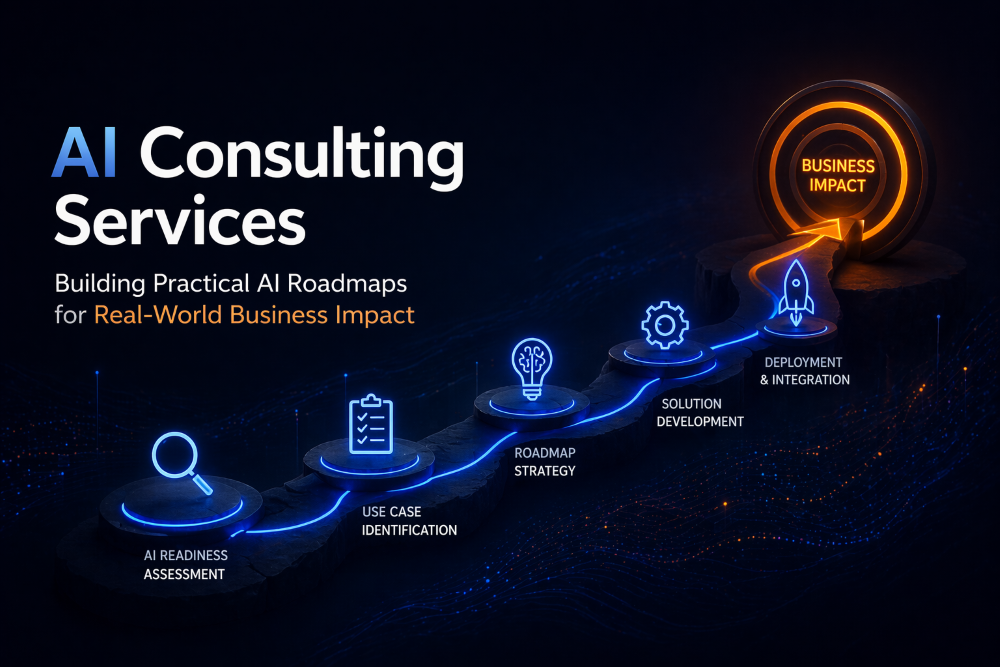
The structure typically moves through four stages:
1. AI readiness assessment
Before recommending anything, a credible AI consulting partner assesses where the business actually stands: the current state of data infrastructure, existing technology stack, team capability, and the specific operational areas where AI could drive measurable change. This isn't a checkbox exercise — it's the foundation that determines whether the roadmap is buildable or aspirational.
2. Use case prioritization
The best use cases to start with are not necessarily the most ambitious. They're the ones where the data is relatively clean, the outcome is clearly measurable, and the operational stakeholders are genuinely invested in the result. Starting there builds momentum, produces evidence of ROI, and creates the organizational trust that more complex use cases require down the line.
3. Data architecture and integration
AI doesn't work without data. Data science consulting at this stage focuses on building the pipelines, integration layers, and governance structures that make AI inputs reliable. This includes connecting siloed systems, establishing data quality standards, and creating the audit trails that regulatory compliance requires. For businesses also operating in Pune, cross-border data residency requirements under Indian data protection law add another layer that needs to be planned for from the start. VirtueByte's data science and business analytics practice is built specifically for this kind of cross-regional data architecture work.
4. Phased deployment and governance
Deployment happens in phases, not as a single launch event. Each phase includes defined success metrics, user adoption planning, and monitoring protocols. Governance frameworks — covering model explainability, bias testing, access controls, and compliance documentation — are built alongside the deployment, not added later when a problem surfaces.
Where AI Delivers the Fastest ROI in 2026
Theory matters less than outcomes. Across implementations in Austin and Pune's business markets, the use cases generating the fastest and most measurable return in 2026 fall into four categories:
Predictive analytics for operational decisions
Demand forecasting, inventory optimization, churn prediction, and maintenance scheduling are all well-established AI applications with mature tooling and clear measurement frameworks. For manufacturing, logistics, and professional services businesses, these often represent the highest-ROI entry point because the data is usually available and the operational cost of getting it wrong is concrete.
Intelligent automation of high-volume workflows
Document processing, data entry, customer query routing, and compliance reporting are processes that consume significant human time without requiring human judgment. Machine learning models built on historical process data can handle these at scale, with human review reserved for edge cases. The efficiency gain is usually visible within weeks of deployment.
Generative AI for customer and content operations
Generative AI tools — built responsibly on the organization's own data rather than public models — are increasingly practical for customer service, internal knowledge retrieval, and content generation workflows. The governance dimension is particularly important here: which data the model can access, how outputs are reviewed, and how the system behaves when it encounters queries outside its training scope all need to be defined before deployment.
AI-augmented sales and CRM intelligence
Lead scoring, next-best-action recommendations, and customer lifetime value modeling are areas where AI adds measurable value to sales operations without replacing the human relationship. The data for these models typically already exists in the CRM — it just hasn't been structured and activated. VirtueByte's Salesforce consulting and implementation work often includes this layer of AI augmentation as part of a broader CRM optimization engagement.
The Austin and Pune Dimension
Austin's business environment in 2026 is characterized by high expectations and a relatively mature appetite for AI adoption — companies here have largely moved past asking whether to invest in AI and are now asking how to do it well. The talent pool is deep, the ecosystem of AI tool vendors is dense, and the risk of being outpaced by a competitor that's further along is real and proximate.
If we take an example with other cities, Pune's technology sector is navigating a related but distinct set of pressures. As one of India's most significant technology and business process hubs, Pune-based companies are rapidly building AI capabilities — both for their own operations and as part of delivery for global clients. The challenges here often center on data quality at scale, cross-system integration, and demonstrating AI outcomes that meet international client standards. Businesses operating across both cities benefit from AI consulting services in Austin that understand both markets — because the strategy that works locally and the architecture that works globally need to be the same strategy.
Choosing the Right AI Consulting Partner
The consulting partner you choose for an AI engagement is not a procurement decision — it's a strategic one. The firms worth working with are the ones that push back on unrealistic timelines, ask hard questions about data quality before promising capabilities, and measure their success by business outcomes rather than models deployed.
Three questions cut through most of the noise quickly:
● Do they start with your business problem or their preferred technology? A consulting firm that leads with a specific AI tool or platform is selling a product. A consulting firm that leads with a discovery conversation about operational friction and business goals is doing strategy.
● Can they show a case study where AI failed to deliver as planned, and explain what they did about it? Anyone who claims perfect outcomes across every engagement hasn't done enough of them. Intellectual honesty about failure modes is a strong indicator of genuine expertise.
● Who owns the ongoing performance of the AI system after deployment? If the answer is unclear, the engagement will end at go-live — and most of the value in AI systems comes from the tuning and iteration that happens after the initial deployment.
AI That Works in Practice, Not Just in a Pitch
The difference between an AI initiative that changes how a business operates and one that produces a slide deck is not the ambition of the goal. It's the quality of the foundation underneath it — the data architecture, the use case selection, the governance structure, and the adoption planning that determines whether the technology actually sticks.
If your business is ready to move from AI interest to AI impact, the starting point is a realistic assessment of where you stand and a sequenced plan for getting where you want to go. Explore VirtueByte's AI and machine learning consulting services to understand what that process looks like in practice — and what it takes to build AI systems that hold up outside a demo environment.
Related Blog Posts
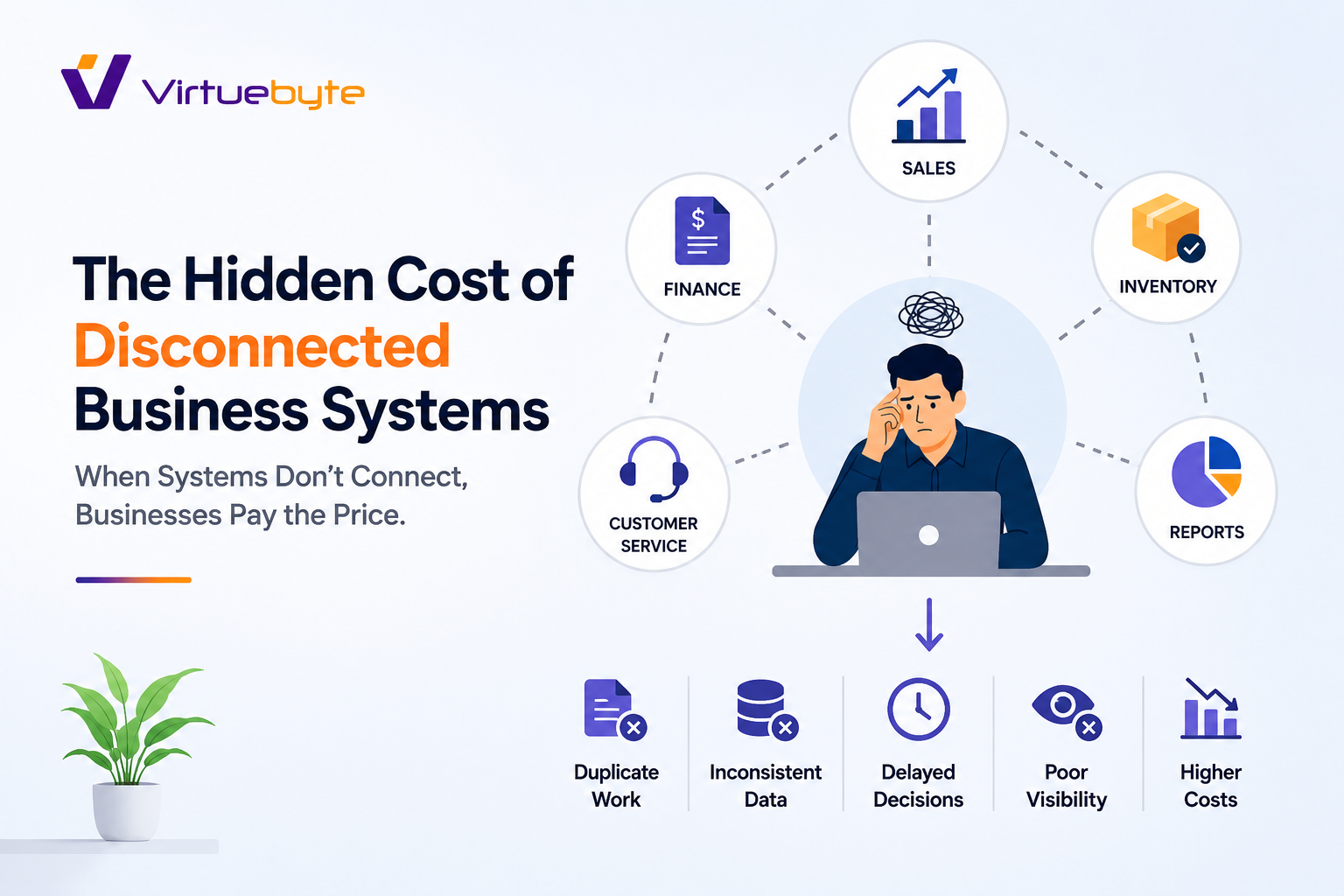
The Hidden Cost of Disconnected Business Systems: Why Integration Matters for Business Growth
Many businesses use different software for sales, finance, inventory, and customer service. While each system works independently, the lack of integration often leads to duplicate work, inconsistent data, delayed decisions, and limited visibility across operations.
Learn More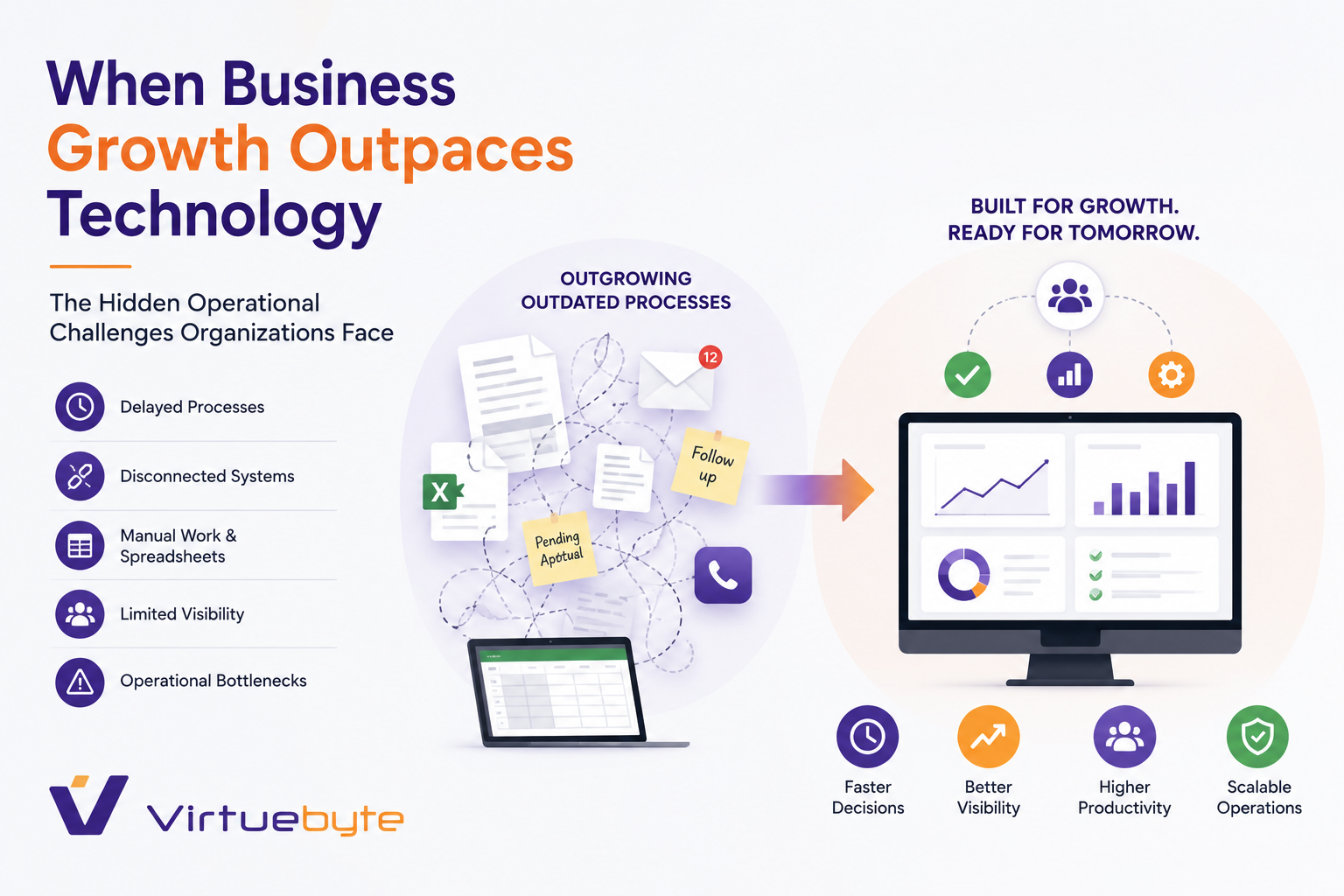
When Business Growth Outpaces Technology: The Hidden Operational Challenges Organizations Face
When Business Growth Outpaces Technology: The Hidden Operational Challenges Organizations Face
Learn More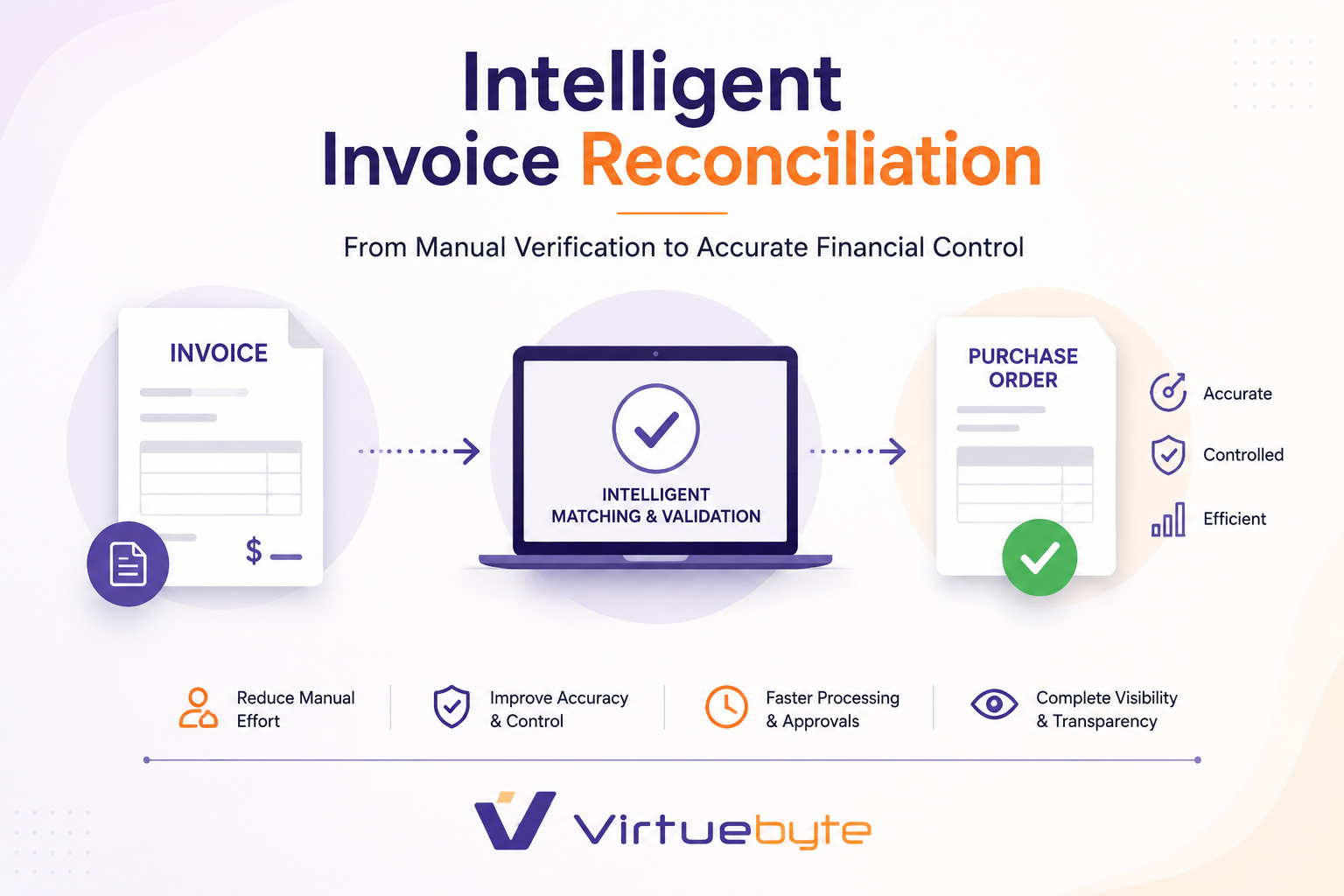
Intelligent Invoice Reconciliation: How Automated PO and Invoice Matching Improves Financial Accuracy
How Intelligent Invoice Reconciliation Improved Financial Accuracy and Operational Control
Learn More