
What to Look for in a Software Development Company: From MVP to Scale-Ready Architecture
/What to Look for in a Software Development Company: From MVP to Scale-Ready Architecture
Choosing the right software development company in Austin is one of the highest-leverage decisions a founder or product leader will make. Get it right, and you have a technical partner that helps you ship faster, scale smarter, and build with confidence. Get it wrong, and you end up with brittle code, missed deadlines, and a product that can't survive its own growth.
Austin has earned its reputation as the new Silicon Hills — home to a thriving startup ecosystem, world-class engineering talent from UT Austin, and a culture that rewards bold, technology-first thinking. At the same time, global demand for high-quality, cost-effective engineering has made cities like Pune, India, a powerhouse for custom software development talent. The best partnerships today bridge both worlds.
Whether you're validating a product idea, preparing for a Series A, or modernizing legacy infrastructure, this guide will walk you through exactly what to look for — so you can make a decision you'll still be proud of at scale.
1. Start with the MVP Mindset — But Plan for Scale from Day One
There's a real tension in early-stage development that not enough people talk about honestly: you need to move fast, but if you move so fast that your foundation is wrong, you'll pay for it later — usually at the worst possible time, like right after you close a funding round. The best software development companies in Austin TX understand both sides of this, and they hold them in balance.
When you're evaluating a partner for your MVP, these are the signals worth watching:
• Scope discipline: A good team will push back on your feature list. Not because they don't want the work — but because they understand that building too much in V1 is how products die quietly. If they're not asking you "does this absolutely need to be in the first version?" — that's a problem.
• Architecture awareness: Lean doesn't have to mean short-sighted. Even a scrappy MVP should be built on data models and service patterns that don't force a full rewrite the moment you hit real user load. Ask them directly: what does your system look like at 10x current scale?
• Deployment readiness: CI/CD pipelines, containerization via Docker or Kubernetes, infrastructure-as-code — these aren't things you bolt on later. Teams that treat them as optional are usually the same ones where production deployments take half a day and nobody can explain why.
A software development company teams actually trust isn't going to build exactly what you spec out and call it done. They'll question assumptions, stress-test your logic, and design systems that hold up when growth stops being theoretical.
2. Evaluate Technical Depth, Not Just the Tech Stack
Every agency you talk to will rattle off the same list: React, Node.js, Python, AWS, maybe some Go or Rust if they want to seem current. That's table stakes. The actual differentiator is whether they understand why those choices exist — and what happens when those choices run into production reality.
Go beyond the stack list. Ask questions that force specificity:
• "Walk me through how you've handled database performance as a product scaled from a few thousand to a few million records."
• "How have you structured multi-tenant SaaS applications — shared schema, separate schemas, something else?"
• "What's your approach to API versioning when you're supporting multiple client versions at once?"
Strong custom software development teams will answer those with real examples — specific tradeoffs they navigated, specific outcomes they hit. Weaker teams will start talking about their "proven processes." That's a polite way of saying they don't have a direct answer.
Also probe on cloud-native architecture: how they think about microservices versus a well-structured monolith, where serverless makes sense versus where it introduces more problems than it solves, and how they instrument observability. OpenTelemetry, Datadog, Grafana — not as names to drop, but as tools with real operational implications. These are the infrastructure decisions that determine whether your product is maintainable a year from now.
3. Look for Agile Execution with Engineering Discipline
"We're Agile" has become almost meaningless. Every team says it. What actually separates strong teams from average ones is what their Agile practice looks like in the details — and whether the engineering discipline underneath it matches the process confidence on top.
Process signals worth evaluating:
• Transparent sprint planning: Shared backlogs that clients can actually read. Velocity tracking that's honest, not padded. Conversations about capacity that happen before commitments are made, not after they're missed.
• Code review culture: Pull requests reviewed by senior engineers who actually push back, not rubber-stamped to hit velocity targets. Testing coverage that someone is genuinely accountable for.
• DevOps integration: Automated deployments as a standard, not a milestone. Environment parity that means "works in staging" actually predicts "works in production." Rollback plans that exist before go-live, not after the incident.
The software development companies in Austin that have a real reputation treat their delivery process the same way they treat the product — they iterate on it, they improve it, and they're honest when something isn't working. That discipline has a measurable downstream effect: fewer bugs in production, faster cycles, and significantly fewer situations where someone's getting called at 2 AM.
4. Assess Communication, Transparency, and Cultural Fit
Technical skill matters, but plenty of technically strong partnerships have collapsed because the communication wasn't there. This is especially true when you're working with a nearshore development Austin team — or any global partner bridging time zones between Austin and a city like Pune.
Watch for these early signals during discovery conversations:
• They ask more questions than you were expecting before they give any estimates. That's a sign they understand scope before they quote.
• They surface risks proactively — things you didn't ask about but needed to know.
• They have a structured onboarding process and know exactly who owns what.
• Engineering and project leadership are accessible to you directly — not filtered through a relationship manager whose main job is keeping you calm.
The red flags are pretty consistent: timelines that are vague until you push, reluctance to share references or real case studies, and a tendency to say yes to everything during sales. If a team hasn't built something similar to your product before, they should say so and explain how they'll close that gap — not pretend the gap doesn't exist.
5. Demand Proof: Case Studies, Client References, and Live Products
The offshore software development market is crowded with agencies that present well and deliver inconsistently. So is the local Austin market, for that matter. The most reliable way to tell the difference is to look past the pitch deck and at the actual work.
Before any contract is signed:
• Ask for case studies with real structure: Not just a list of clients and logos. What was the actual technical problem? What did they build, and how? What were the results, and are those results verifiable?
• Look at live products: If they built it, you should be able to use it, or at least see it running. A working product in the real world tells you more than any portfolio page.
• Talk to references directly: Not testimonials on their website — those are curated. Get names you can call and ask specific questions: Were timelines accurate? How did they handle the moment something went sideways? Would you hire them again?
At Virtuebyte, transparency is foundational. Our clients have access to project dashboards, engineering metrics, and sprint reports in real time — because we've found that informed clients consistently make better product decisions, and that's better for everyone.
6. Scale-Ready Architecture: The Criteria Most Teams Miss
Most conversations about choosing a software development company circle around cost, turnaround time, and which technologies they use. Those are reasonable questions. But the one that matters most at growth stage rarely gets asked: "If this product gets 100x the users we have today, does the architecture hold — or do we rebuild?"
A system that's actually built for scale has some recognizable characteristics:
• Horizontal scalability: Stateless services that can be spun up in parallel without shared-state bottlenecks creating a ceiling on your throughput.
• Async event processing: Message queues — Kafka, SQS, RabbitMQ — that pull heavy processing out of the request path so users aren't waiting on things that don't need to be synchronous.
• Observability by design: Logging, distributed tracing, and alerting that are built into the system from the start. Not something you add after the first major incident makes it obvious you needed it.
• Multi-environment parity: Development, staging, and production that behave consistently. When they don't, you get bugs that only appear in production and nobody can explain — which is one of the more frustrating and time-consuming problems a team can face.
If these topics don't come up during scoping conversations, pay attention to that. The teams that build for scale think about scale before writing a single line of code — not as an afterthought when things start breaking.
Whether you're evaluating a SaaS development partner in Austin or sourcing engineering execution from Pune, these architecture questions are the ones that separate vendors from genuine technical partners.
Ready to Build Something That Lasts?If you're looking for a software development company in Austin that brings real MVP experience, architecture that holds at scale, and a delivery process you can actually see into we'd like to talk. Whether you're in Austin, Pune, or somewhere in between, Virtuebyte is built for founders and product leaders who aren't willing to trade speed for quality, or quality for speed.
Related Blog Posts
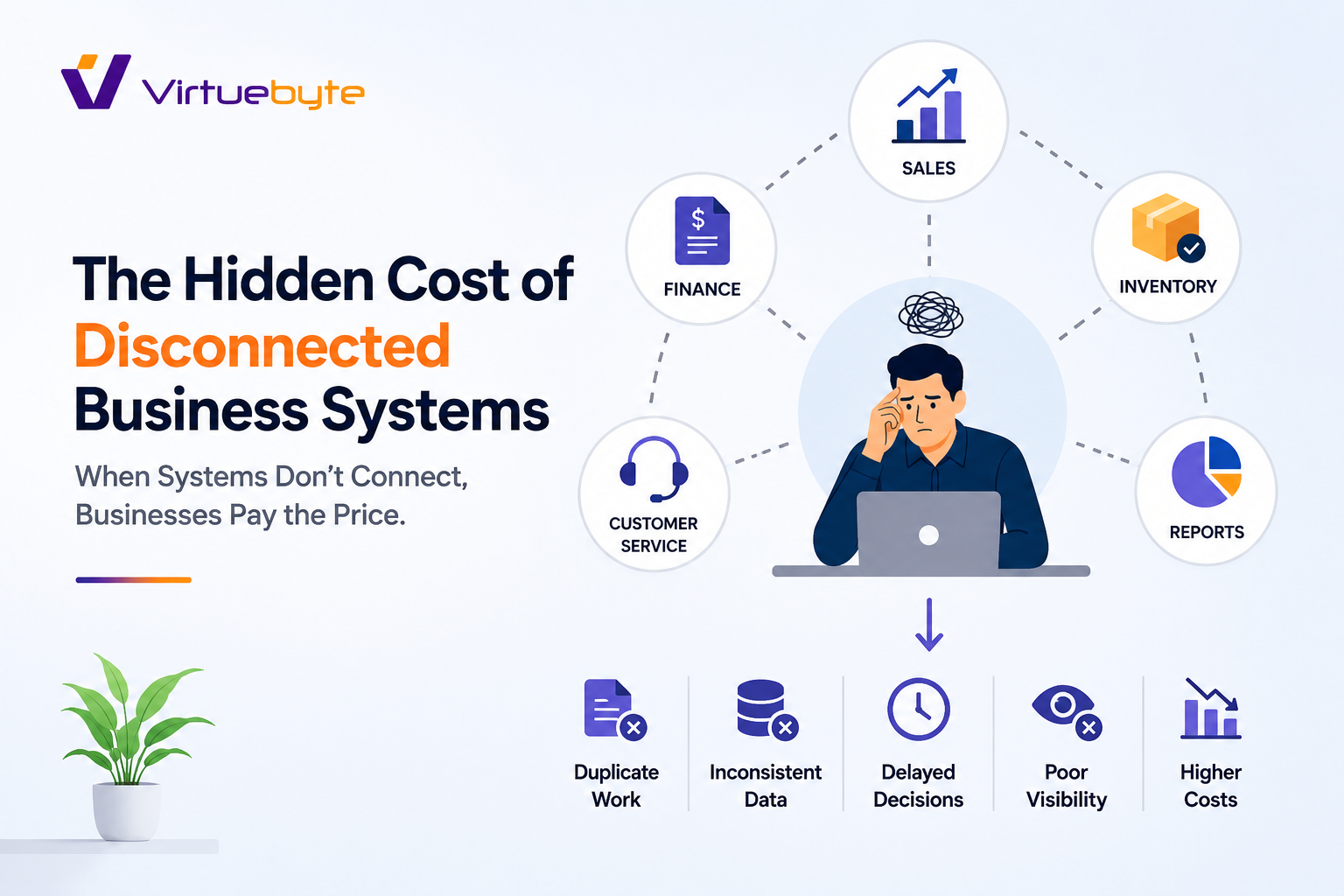
The Hidden Cost of Disconnected Business Systems: Why Integration Matters for Business Growth
Many businesses use different software for sales, finance, inventory, and customer service. While each system works independently, the lack of integration often leads to duplicate work, inconsistent data, delayed decisions, and limited visibility across operations.
Learn More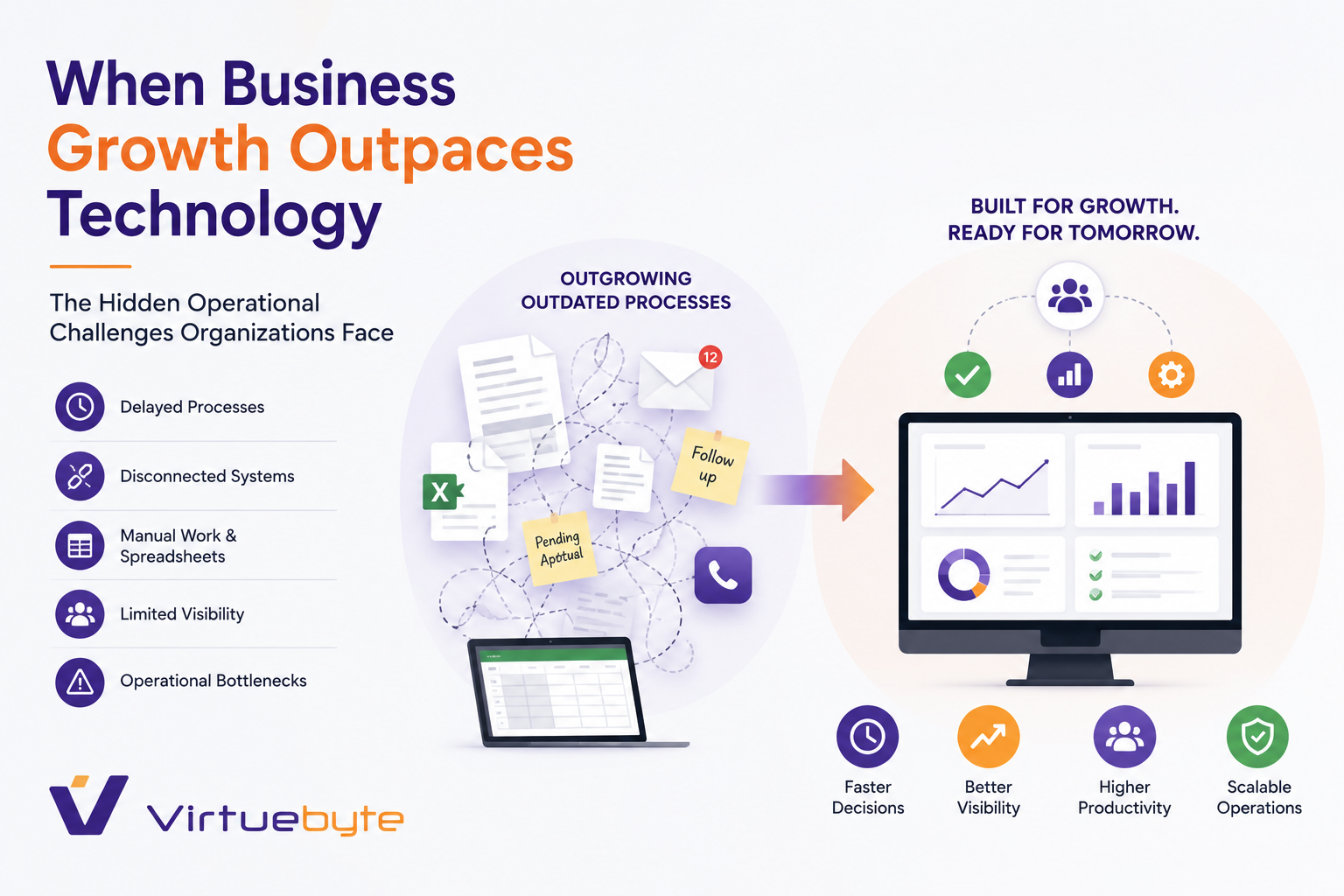
When Business Growth Outpaces Technology: The Hidden Operational Challenges Organizations Face
When Business Growth Outpaces Technology: The Hidden Operational Challenges Organizations Face
Learn More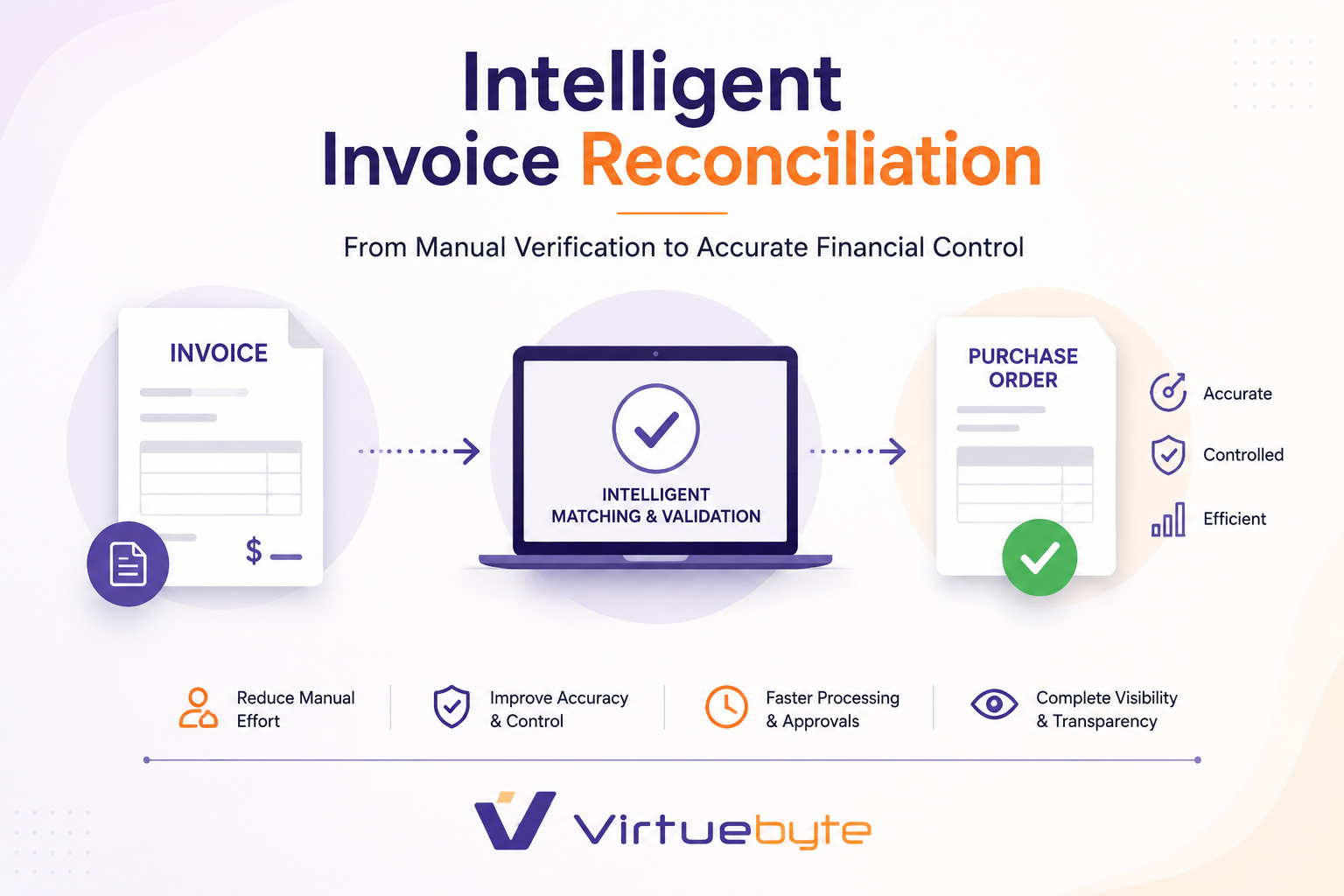
Intelligent Invoice Reconciliation: How Automated PO and Invoice Matching Improves Financial Accuracy
How Intelligent Invoice Reconciliation Improved Financial Accuracy and Operational Control
Learn More